
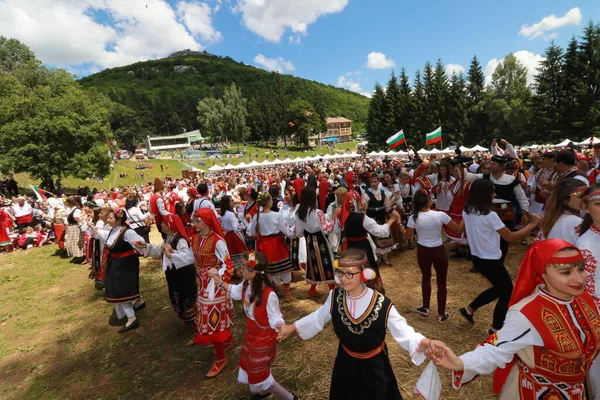

Bulgarian folk dances are the dance art of the Bulgarian people.
Bulgarian folk dances have a rich tradition. Traditionally, mass dances predominate in Bulgarian choreography. Dance styles vary by region. Many dances have historically been performed to two-part or choral singing. Bulgarian dances have a complex rhythmic pattern. In many dances, the musical and dance phrases do not coincide. Dances are one of the most widespread forms of folk art in Bulgaria. They are ritual, carnival, calendar-celebrating, and work-related.
This is the definition given by the bare facts, but at a deeper level, Bulgarian folk dances are more than just moving to music. They are a way of remembering. The memory of the body has survived centuries, wars, migrations, changes of empires and languages. When people in Bulgaria join hands and form a horo, the boundary between past and present disappears: the same step, the same rhythm from hundreds of years ago, resounds once again in the earth beneath their feet.
They are immediately recognizable by the broken, uneven breath of the music. Where the European ear seeks an even count, Bulgarian dance offers a different order—a living, human one. Seven beats, nine, eleven—they are not counted, but experienced. Step—pause—push—step again. The body learns to listen differently.
In Bulgaria, dance is not confined to the stage. Its place is the square, the courtyard, the meadow, the village street. Anything can serve as an occasion for dancing: holidays such as weddings, christenings, village gatherings; calendar holidays—especially in winter and spring, when ancient rites intertwine with Christian tradition; folklore festivals, of which there are dozens in the country, from small regional ones to huge national ones; Just in the evenings: the music turns on, people come out to the square, and the horo assembles spontaneously, without announcement.
Bulgaria also has a special sense of timing: the dance doesn't happen "on schedule," but when people are ready to be together.
Surprisingly, Bulgarian folk dancing hasn't become a thing of the past. On the contrary, it has experienced a noticeable revival in recent decades. Cities have dance clubs where office workers, students, and IT professionals go after work, for joy and a sense of roots. Young people increasingly choose horo not as a "duty," but as a form of lively communication. Folk dancing is taught in schools and universities, and professional ensembles are renowned far beyond the country's borders.
For many Bulgarians, dancing is a way to say, "I'm here. I'm part of this place."
Each region dances differently, but all movements share a common thread: stability. The feet are firmly planted on the ground, the body is composed, the movements are precise. Even in the fastest dances there is an inner restraint, a strength without ostentatious showiness.

Horo isn't just one dance. It's an entire world, as multifaceted as Bulgaria's mountain trails. What they all have in common is clasped hands, moving in a circle or chain, and the feeling of shared breathing. But look closer, and each type of horo reveals a distinct character, a distinct way of being together.
Pravo horo
The most recognizable and, perhaps, the most popular.
It begins simply: a step to the right, another step, a gentle sway—as if the earth is testing its memory. Pravo horo is danced in squares, at weddings, at the end of a long day. It's easy to enter and difficult to exit: the circle draws you in, the rhythm lulls you, and suddenly you realize you're dancing not so much with your feet as with your memory. This horo is open to everyone—it's often where people begin their encounters with dance and community.
Rchenitsa
If prova horo is the calm flow of a river, then rchenitsa is its swift rapids.
It's sharp, lively, and sparkling. It's often danced alone or in pairs, as if challenging the music. The 7/8 time signature keeps you on your toes: the steps are sharp, the movements short, almost conversational. Rchenitsa is a dance of character. The dancer's personality is evident in it: some are playing, some are arguing, some are smiling at the music itself. This is a horo where tradition allows for improvisation, where a person momentarily steps out of the circle and asserts themselves.
Daichovo horo
This horo is like the gentle rocking of a boat.
The 9/8 rhythm creates a feeling of smoothness, fluidity. The movements are unhurried, the steps seem to flow into one another. It is often danced in a long chain, moving across the square, like a procession without beginning or end. Daichovo horo doesn't require strength—it demands sensitivity. It's important to listen to your neighbors, to sense the general direction, without upsetting the balance.
Kopanitsa
Kopanitsa—a test
A sharp rhythm, a fast tempo, a complex count. There's no room for distraction: every step must be precise, every accent heard. Kopanitsa is danced confidently, almost boldly. It often becomes the culmination of the celebration—the moment when the dance becomes a demonstration of skill and inner composure. This horo isn't for everyone, but that's precisely what makes it so captivating.
Shopskie horo
They combine severity and humor.
Shopskie horo is recognizable by its springy movements, sharp accents, and almost deliberate severity. The body is restrained, the steps are firm, as if the dancer is arguing with the earth and yet still holds their ground. This horo is a forceful and stubborn dance, a reflection of the character of the region around Sofia—direct, a little caustic, but honest.
Pirin and Thracian horo
Here, the horo becomes softer, broader.
In the Pirin region, the movements flow and turn, as if singing along with the mountains. In Thrace, the steps open up, the dance becomes festive, spacious, like a field in summer. These horos seem to look not inward, but outward—into space, into light, into sound.
No matter what kind of horo is danced, its essence remains unchanged. It is a dance where no one is alone. Even when the step is complex, even when the rhythm breaks, there is always someone's hand, someone's shoulder, someone's movement, adapting to yours.
And perhaps it is precisely in this diversity of horo that its main secret lies: it allows everyone to be themselves without leaving the circle. Horo unites people in a circle or a chain, and this has a profound meaning. Here, there is no primary or secondary: everyone is important, everyone supports each other. The dance becomes a conversation without words, where the step is a phrase, and the rhythm is the breathing of a shared body.
And perhaps this is why Bulgarian folk dancing is still alive. As long as people hold hands and feel the rhythm of the person next to them, the tradition continues

I want to know more about current real estate offers